







Virtual Hydlide

“Virtual Hydlide is a Perfect 3-D Reproduction of the Original.”
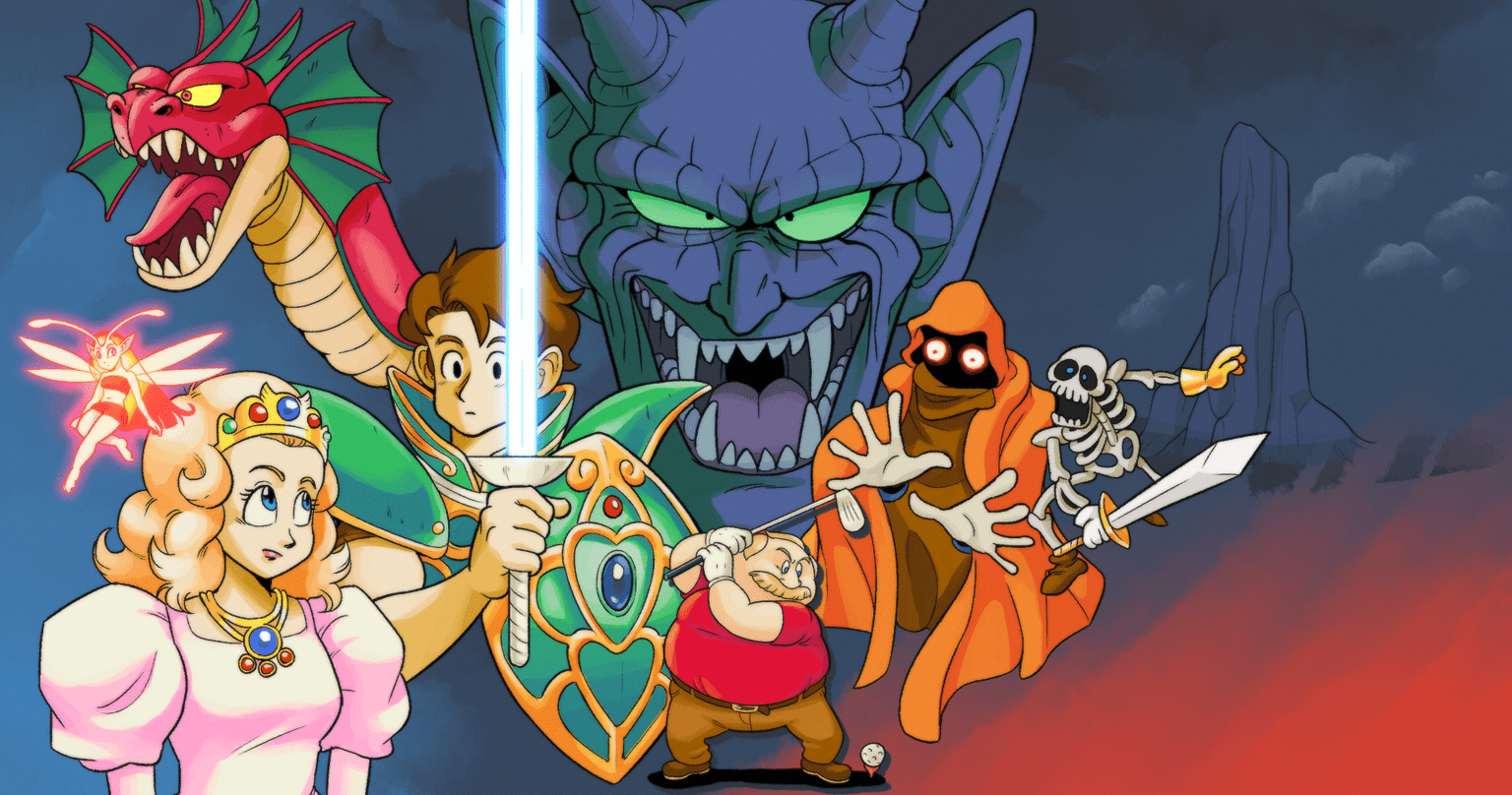
“Combination of Real Images and Computer Graphics to Create Realistic Worlds.”
Fantastical, virtual art by @morkitten.

History has a funny way of reflecting on innovators. If you look back on popular canon, it’s never the folk “who tried and failed” who get their due: It’s the dudes who step in afterward, who can capitalize on the groundwork laid. You don’t hear too much about Antonio Meucci’s ‘talking telegraph,’ but Alexander Graham Bell’s derivative telephone has gone on to be credited as a game-changer for communication. Galileo effectively stole his idea for the telescope from Johann Lippershey’s ‘kijker,’ whose misfortune was not being able to secure a patent for his original optical instrument. And there but for the grace of God goes Hydlide; which couldn’t precisely nail its attempt at a still-theoretical “action RPG” on the first go, and has suffered obscurity in the shadow of The Legend of Zelda in the 35 years since.

… Well, that’s only a somewhat accurate framing around Hydlide‘s legacy, actually. For one, there’s the fact that Hydlide was actually quite successful right out the gate in Japan — selling a million copies across its personal computer formats, before managing a subsequent second million with an enhanced Family Computer remake. Then there’s the fact that it had an enduring enough of a legacy to warrant two sequel installments; before reimagining their franchise-starter not just once, but twice more on more modern platforms for good measure. The fact of the matter is, the Hydlide series would be cited as an influence for many of the Japanese ARPGs to follow in its footsteps — that it helped establish the very foundation of the flourishing subgenre. So, really, that whole bit about Hydlide being forgotten or overlooked by history? Turns out that only really applies outside of its native Japan, where few of us Westerners turn out to have much in the way of real insight into its storied legacy. Blame James, I suppose.

With all that in mind, there’s the matter of one of those aforementioned “reimaginings” that perhaps warrants a second look. Looking toward the future of graphics and level-generation technology – and perhaps seeking to once again present their franchise as the flagbearer for the action RPG genre – T&E Soft set forth to summon Virtual Hydlide for the Sega Saturn. And again, we’ve all been told to believe its derision should be unanimous — that it is a virtual adventure without merit, worthy only of mockery in the modern canon. Which leaves me to determine: Is Virtual Hydlide’s expedition into a digitized Fairyland truly detestable? Or is it perhaps a hero’s journey after all, worthy of our collective reconsideration? And thus begins my own odyssey; to explore Hydlide’s historical context, join the brave knight Jim on his randomly-generated quest, and to return with newfound enlightenment.

“Enough said, here we go.”

Posted in Game Reviews  |  , , , , , , ,  |  4 Comments

Yaroze a Day #04

BETWEEN THE EYES | BILL’S SHOOTING GAME | BLACK WIDOWBLASTER |
BLITTER BOY | BLOCK BREAK | BLOCKOUT

Welcome back to the fourth installment in our ongoing feature, Yaroze a Day! In this series, we’re attempting to cover the complete catalogue of games compiled in the unofficial “Net Yaroze Collection 2014,” and giving each of them brief explorations and reviews. Each bi-weekly bi-monthly bi-annual occasional update provides seven titles for your viewing pleasure, and additionally attempts to discover any deeper stories behind the games and their respective developers.

Today’s return picks up where we last left off, as we continue to make our way through titles beginning with the letter ‘B,’ and brings us one of the most notable releases to hail from the European Yaroze community. While you certainly don’t have to have read through all the preceding articles and reviews in order to understand the games we’ll be covering today; we would at least recommend reading our primer on the subject of the Net Yaroze hardware and introduction to this series, which you can find here. With all that stated, please to enjoy this update’s assortment of oddities and obscurities!

Posted in Yaroze a Day  |   |  3 Comments

SSFF: Surprise 3D in GBA Games | Punching Weight

SURPRISE! Here’s the first episode I helped write for one of my favorite YouTube channels (and inaugural “Cool Cats” inductees), Stop Skeletons From Fighting! I’ve been sitting on this secret for a hot minute now – something like the past couple of months – and I’m excited that I can finally reveal it to y’all.

Derek and Grace have always been cool as hell to me, and I’m pumped to be able to collaborate with them. SSFF’s appreciation for games that seek to overachieve – which try [and sometimes fail] to push the limits – aligns perfectly with my own. Their willingness to dive deep into all manner of obscurities and oddities has always made for fascinating viewing, and I’m psyched to be able to lend a hand to them.

Posted in Off-Site Works  |  ,  |  3 Comments

Spelunker (NES)

“NEVER FALL!!!”

“You can only fire when standing on solid ground.”
Spelunker Japanese box art.

In the annals of kusogē history, perhaps no other console has played host to quite so many notorious games as Nintendo’s Family Computer. And within that catalogue of infamous cartridges, there is a trio which stands out — three titles tied together by shared theming and similarly punishing gameplay. These releases would include Sunsoft’s Atlantis no Nazo, Pony Canyon’s Super Pitfall, and the subject of today’s article; IREM’s Spelunker. Now, seeing as each game puts players in the boots of fortune-seeking adventurer types – exploring the likes of ancient ruins and lost caverns – I reckon there should really be some sort of nickname assigned to this wholy unofficial trilogy, right? A friend and peer in our field – Natalie of ‘Kusoge Theater’ – has referred to the set as the “Cave Dwellers” collection. A plenty memorable moniker, to be sure. But today, I’d like to pitch my own suggestion here for your approval: “The Treasure Hunters Trinity.” A little alliteration goes a long way, I say.

Regardless of what you want to call this selection of games (if you even see fit to connect them together in the first place), Spelunker is the release which set the boulder rolling. With its December 6th, 1985 release date, it predates both of its contemporaries by several months. Not only that, but the game upon which it is originally based – MicroGraphic Image’s Atari 8-bit version of Spelunker – was launched two years earlier in 1983. And while there’s a further point to be made that all three games in this trio likely owe their inspirations to the success of Brøderbund’s Lode Runner; it’s the Nintendo conversion of Spelunker that set a standard for “badness,” and which serves as the perfect point of entry for our fortune-seeking adventures on Famicom.

Like all great treasures and antiquities, there is a history to be explored here. We’ll be doing our due diligence in unearthing the details of the original Spelunker’s development, before establishing the link to its subsequent reimaginings in Japan. From there, we’ll dig deep into the depths of the infamous Famicom / NES cartridge, and see if there’s any gold to be mined from it. Finally, we’ll examine the impact Spelunker had on the market and industry, and the enduring cultural legacy it still manages to hold. But before embarking on this expedition, we should all do well to remember the adage that “One man’s trash is another man’s treasure,” and try our best to approach today’s finds with open minds. Bearing all that in mind, it’s high time we start spelunkin’.

Posted in Game Reviews  |  , , , , , , ,  |  1 Comment

XDR: X-Dazedly Ray

“The Fate of the Planet Sephiroth is in Your Hands!!”

“The most beautiful and highly advanced planet in the galaxy, ‘Sephiroth.'”
Japanese Mega Drive cover.

Scrolling shooters: The final frontier. This is the voyage of the starship ‘DR.’ Its single mission: To defeat the Guardia Army. To protect the planet Sephiroth in its hour of need. To stink up Sega’s Mega Drive like no shmup has stunk before!

XDR: X-Dazedly Ray’s reputation as a piece of 16-bit kusogē isn’t known to many outside of Japan (its sole territory of release). Hell, it’s almost barely recognized even in its native Nihon, where its claim to “fame” is in the fact that it was so beloathed by the few folk who played it as to earn it something like a permanent spot near the very bottom of Beep! MegaDrive magazine’s “Reader’s Race” charts — in competition with nearly the entirety of the rest of the country’s console library! Even more obscure than the game itself is its one-time developer and publisher, UNIPACC; who would appear to fold almost immediately following the lukewarm reception to their debut title. Needless to say, the short-lived nature of XDR and its creators means that there isn’t all that much info to go around regarding the pair, especially on the English-speaking end of the web. Needless to say (again), that’s where the Bad Game Hall of Fame steps in.

Today, we’ll be staring straight into those dazedly rays in order to report on the brief history of the team behind the release, to review the contents of the cartridge, and ultimately see if we can’t figure out what UNIPACC’s plans for the future might’ve been. Along the way, we’ll reveal several of the staff responsible for the game’s development, determine if XDR truly deserves its lowly reputation, and – perhaps most importantly – explain what the hell an “X-Dazedly Ray” is even supposed to be. The story of Ray Starbreaker and his ‘Operation X’ will finally be told!

These results as per the final issue of Beep! MegaDrive’s publication run. For reference: XDR would rank as the Mega Drive’s third place lowest-rated title (positioned #477 out of 479 / scoring 3.0269 out of 10); just above Double Dragon II: The Revenge (#478 / 3.0214), and Sword of Sodan (#479 / 2.8954).

Posted in Game Reviews  |  , , , , , ,  |  4 Comments